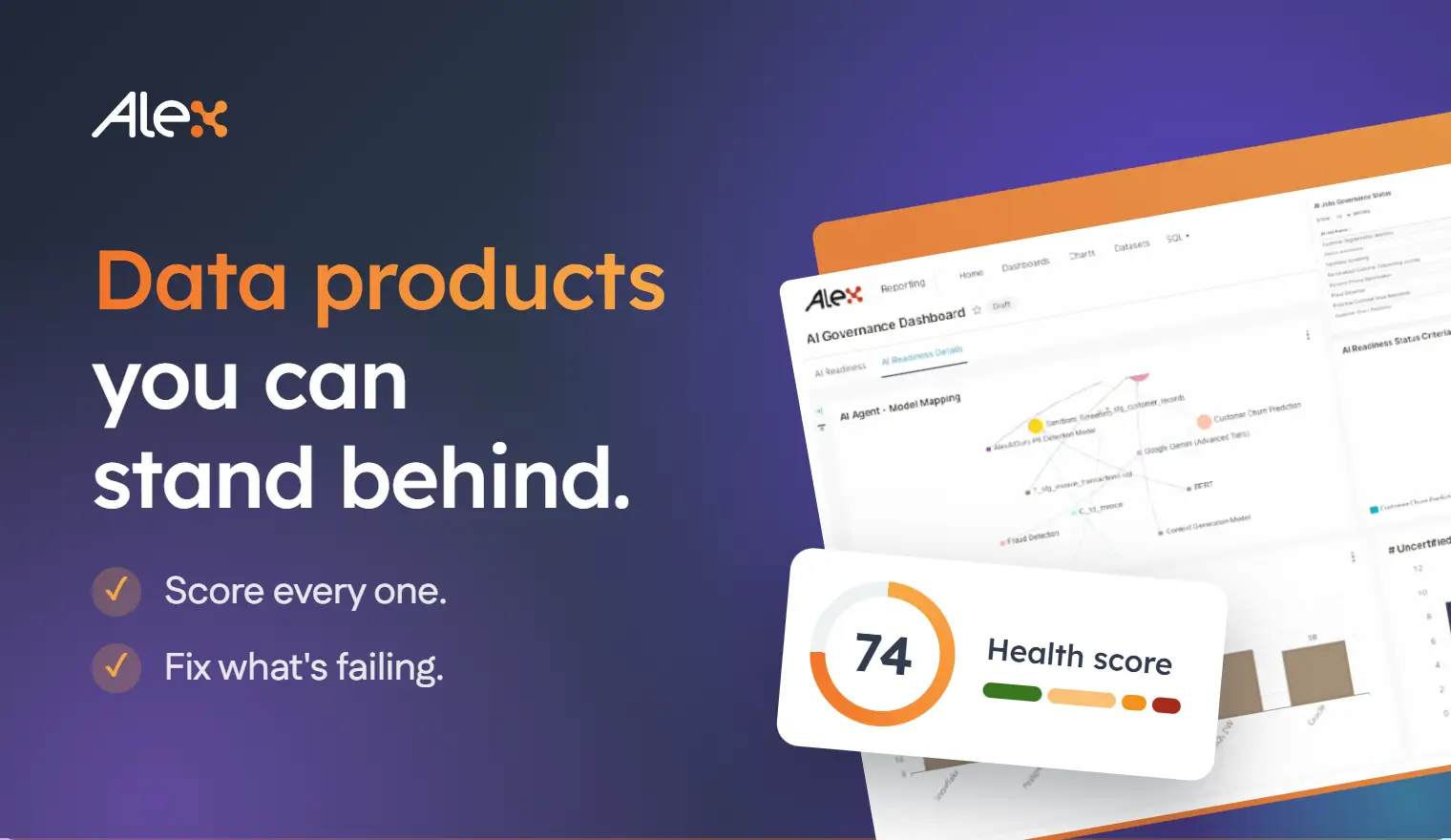



Alex unites the business context behind every dataset, report and AI agent, so nothing breaks silently or goes unexplained.
Unified data operations and context intelligence platform. Catalog, lineage, quality, data products, marketplace, policy, privacy, workflows, context, governance, ontology, and connectors — built together. Run prebuilt, or your own.

One subscription covering the platform and the prebuilt business solutions on it. No seats, no agents, no connector counts. Scalable, transparent, predictable.

Unlimited users, and the AI tools they bring. Any assistant can reach your governed context through the Alex MCP server, with no per-connection licence. Access is never a budget decision.

Business solutions ship with the solution marketplace — proven user journeys you configure rather than commission. Fewer consulting days, shorter implementations, value in weeks.

Having worked on a number of data management related tools and vendor, my experience of implementing and working with the Alex Solutions has been excellent.
“Provides a strong technical platform to support a range of data governance activities across both business and technical use cases.”
“The Alex team is a pleasure to work with. They are very professional and put my needs ahead of everything else.”
“The Alex platform deals with high complexity lineage better than any others we’ve seen.”
“Alex Solutions is a great vendor to work with for your metadata governance needs.”
“Alex has been great to work with, the team is responsive and the product works well.”
“Our experience with Alex has been generally positive, especially in consolidating multiple data governance functions into a single platform.”
“It makes it much easier for me to find, understand and trust the data I work with every day.”
“The platform offers solid data governance features that make a big difference in my day-to-day work.”
“Highly capable metadata management platform that stands out for its ease of use, AI integration, strong data lineage, and flexible deployment.”
“The interface is easy and handles data tasks effectively without complexity, helping me trust my data and reduce manual checking.”
“It’s like getting a Bentley for the price of a Ford.”
“If you are looking for a metadata management tool, you should look no further than Alex.”
“The Sales team and Implementation team go above and beyond in helping you out and deliver what they promised.”
“Provides a strong technical platform to support a range of data governance activities across both business and technical use cases.”
“The Alex team is a pleasure to work with. They are very professional and put my needs ahead of everything else.”
“The Alex platform deals with high complexity lineage better than any others we’ve seen.”
“Alex Solutions is a great vendor to work with for your metadata governance needs.”
“Alex has been great to work with, the team is responsive and the product works well.”
“Our experience with Alex has been generally positive, especially in consolidating multiple data governance functions into a single platform.”
“It makes it much easier for me to find, understand and trust the data I work with every day.”
“The platform offers solid data governance features that make a big difference in my day-to-day work.”
“Highly capable metadata management platform that stands out for its ease of use, AI integration, strong data lineage, and flexible deployment.”
“The interface is easy and handles data tasks effectively without complexity, helping me trust my data and reduce manual checking.”
“It’s like getting a Bentley for the price of a Ford.”
“If you are looking for a metadata management tool, you should look no further than Alex.”
“The Sales team and Implementation team go above and beyond in helping you out and deliver what they promised.”
Detect change. Understand business impact. Execute governed action. That’s the Alex difference.
Data incidents are almost always discovered downstream, by the people who depend on them — and that detection gap, not the repair, is where the cost sits.
Detects change across sources, traces lineage automatically and triggers governed action.
Reduce disruption and resolve data issues faster.
Analytics and AI are only as good as the context behind the data. Definitions, rules and metrics are inconsistent, unclear or undocumented.
Creates and governs context assets, connects technical, business and operational metadata in a knowledge graph, then distributes that context to people, tools and AI agents.
Increase confidence in analytics and AI through governed business context.
Regulations, policies and controls are difficult to map to data, processes and reports. Audit evidence is manual and time-consuming.
Maps obligations, policies and controls to data, reports and lineage, maintains evidence and version history, and detects change and downstream exposure.
Reduce compliance risk and strengthen audit readiness.
Governance work is manual, fragmented and slow. Stewards are overloaded and business users lack self-service.
Harvests and enriches metadata automatically, classifies, routes and executes governance through reusable playbooks, and enables self-service with guardrails.
Redundant, unused, or low-value assets increase cost and complexity. Usage and value are not visible.
Combines inventory, lineage, ownership and usage to expose redundancy, cost and utilisation — then supports safe decommissioning.
Reduce cost and complexity while improving utilisation.
Not sure where the gap is? That’s exactly what a first conversation is for
A context layer connects raw data to the business meaning behind it: what a metric represents, which policies apply to it, and who owns it. AI agents need this layer to make decisions that are reliable and cost-efficient rather than plausible-sounding guesses. Alex builds this layer automatically by linking data assets, business processes and policies into a single connected model.
Data observability is continuous visibility into the health, freshness and structure of data as it moves through the estate, plus the lineage to know what a change affects. Without it, a broken upstream table reaches a model or a report before anyone notices. With it, the break is caught at the source and its impact is already mapped.
Manual stewardship depends on people documenting, classifying and approving assets one at a time. Automated governance uses metadata to do that work continuously: assets are discovered and classified on arrival, policies execute as workflows, and a steward is only pulled in for genuine exceptions. The policy does not change, the effort to apply it does.
Stop assembling evidence and start retrieving it. When obligations, policies, controls, data and reports are linked in one live chain, and each step keeps its own evidence with version history, an audit request becomes a query rather than a project.
A catalog is an inventory you read. Active metadata is that inventory kept current by the platform and used to trigger work: detecting change, scoring quality, flagging sensitivity, routing a request. The catalog tells you what exists; active metadata acts on it.
Column and table level movement across sources, pipelines, models and reports, including SAP-sourced objects, plus the transformations applied along the way and the people and processes that depend on the result. That is what makes impact analysis possible before a change ships.
Governance defines the rules: ownership, definitions, classification, policy. Data operations is the running of the estate against those rules, every day, at the speed the business changes. Alex covers both, which is why the governance work does not sit in a separate project plan.
Yes, because most estates carry unused, duplicated or unowned reports and datasets that nobody can retire safely without seeing usage and downstream impact. Usage analytics plus lineage make rationalisation defensible, which is where the platform cost reduction comes from.