



How to Rationalise Data and Technology After M&A with Alex Solutions
Executive Summary: Post-merger integration often fails due to fragmented data models and hidden system dependencies. Alex Solutions provides the active metadata fabric required to map these relationships, ensuring a high-confidence rationalisation process that reduces operating costs and technical debt.
After a merger or acquisition, organisations inherit more than just new balance sheets and talent; they inherit a labyrinth of fragmented data models, overlapping platforms, and inconsistent business definitions. While the strategic intent of M&A is often to capture synergies and scale, research suggests that poor integration is a primary reason these deals fail to deliver their projected value. The challenge is rarely the lack of technology, but rather the lack of visibility into how that technology is interconnected.
How can leadership teams move from running parallel, redundant environments to a unified, efficient operating model without disrupting critical business functions? The answer lies in shifting the focus from system-first integration to metadata-first rationalisation.
Table of Contents
The Hidden Complexity of Post-Merger Environments
Common post-merger challenges include duplicated systems across business units, conflicting metrics, and legacy platforms that seem impossible to retire. These issues are not merely technical inconveniences. According to Gartner, metadata management is evolving from simple cataloging to an orchestration platform precisely because organisations need to manage this complexity in real time.
When two organisations merge, they often find themselves with two or more ERPs, multiple CRM instances, and several disparate data warehouses. Attempting to rationalise these by simply “picking the best one” is a high-risk strategy. Two applications may appear similar at the interface level, but their underlying data structures, business rules, and downstream dependencies are often vastly different. Without a deep understanding of these connections, retiring a legacy system can inadvertently break a regulatory report or an automated pipeline three steps down the line.
Why Data Visibility is the Catalyst for Synergy
The real cost of poor visibility is duplication that lingers long after the deal closes. When teams cannot see which datasets, pipelines, dashboards, and reports depend on each other, they are forced to keep redundant systems in place as a safety measure. This “insurance” is expensive, extending operating costs and delaying the capture of synergies.
Alex Solutions addresses this by providing a “single pane of glass” across the combined enterprise. By leveraging an Open Scanner Ecosystem, Alex Solutions can ingest metadata from both modern cloud stacks and niche legacy systems inherited during the acquisition. This allows CIOs and CTOs to see the entire data landscape as a single, interconnected graph rather than a collection of siloed inventories.
Establishing the Source of Truth
Successful rationalisation requires more than just an inventory; it requires a semantic bridge. This is where the Inference Engine from Alex Solutions becomes vital. It automatically identifies relationships and suggests links between disparate data elements from the two legacy organisations. By establishing a unified Business Glossary, the combined entity can ensure that a “customer” or “net profit” is defined identically across all business units, accelerating trust in the new organisation’s reporting.
Four Pillars of Effective Technology Rationalisation
To rationalise data and technology effectively after M&A, leadership teams must move beyond static spreadsheets and adopt an active governance approach.
End-to-End Data Flow Mapping
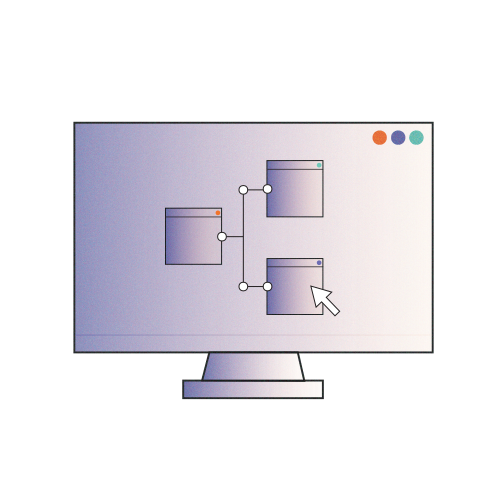
You must visualise how information moves across the combined business units. Alex Solutions enables this through Automated Lineage, which tracks the journey of data from origin to endpoint, revealing how legacy systems feed into the new target architecture.
Cross-Platform Dependency Discovery
Before making any retirement decisions, identify every dependency between pipelines, reports, and the visualisation layer. This prevents the “unplug and pray” method of systems integration.
Usage-Based Asset Valuation
Determine which assets are actually being used. Alex Solutions provides observability into data usage patterns, allowing teams to retire “zombie” reports and unused tables that serve no business purpose.
Downstream Impact Assessment
Use impact analysis to simulate the removal of a system. By understanding the consequences before they happen, organisations can manage risk and maintain continuous compliance with regulations like GDPR or APRA CPS 230.
Integration Governance and Risk Management
Integration governance is the difference between a streamlined organisation and a digital hoarder. McKinsey notes that strong integration management helps organisations realise cost synergies more effectively. In the context of data, this means ensuring that data quality and data security are maintained throughout the transition.
While legacy players like Collibra or Informatica often require manual effort and complex setups to bridge new environments, Alex Solutions delivers an API-first, composable architecture. This allows for a federated stewardship model where domain experts from both merged companies can collaborate on data curation without being slowed down by central IT bottlenecks. This speed is essential for maintaining momentum during the first 100 days post-merger.
Conclusion: Simplicity through Visibility
The biggest blocker to post-merger rationalisation is not the technology itself; it is the lack of visibility into dependencies between systems, data, and business processes. Once these dependencies are mapped via an active metadata fabric, leaders can consolidate platforms with confidence and reduce duplication.
Alex Solutions empowers organisations to turn the chaos of M&A into an opportunity for digital transformation. By automating discovery and providing explainable lineage, we help you move faster toward a simpler, more agile operating model.
Key Takeaways
Rationalise systems based on data dependencies, not just feature sets.
Prioritise automated lineage to identify “safe-to-retire” legacy platforms.
Use a unified Business Glossary to resolve metric conflicts between merged entities.
Ensure continuous compliance by monitoring policy drift during system migrations.
Are you preparing for a large-scale integration?
Contact the Alex Solutions team to learn how our metadata automation can accelerate your path to synergy.