



From Docs to Code: The New Era of Active Data Governance in Europe
Feeling like your Governance Docs Are Obsolete? Here’s What’s Next.
Every company in Europe has one. It’s a well-written document, stored on a server, outlining the firm’s data governance policies. It’s the result of countless meetings, has been approved by the DPO, and is almost completely disconnected from the systems it’s meant to govern.
The moment it was published, it was already obsolete. This document is a static artifact in a world of dynamic data systems. It has no live connection to your data, cannot trigger an alert, and certainly can’t stop a non-compliant process from running.
The traditional model of creating documentation and policing compliance is fundamentally broken. For European businesses navigating a complex web of regulations like GDPR, BCBS 239, AML/KYC directives, and the upcoming AI Act, the future isn’t about writing better documents; it’s about treating policy as active, executable code.
The Shift from Static Docs to an Active Policy Fabric

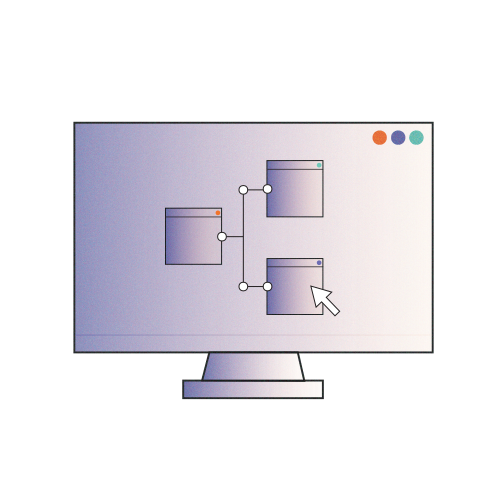
The core problem is that traditional governance treats policies as human-readable suggestions. A modern approach treats them as machine-readable instructions. This is the concept behind an Active Policy Fabric—a central, queryable repository where policies are live objects, not dead text. In Alex Solutions, this is our Business Glossary.
Here, a policy is a structured object with defined attributes, ownership, and direct relationships to the data assets it governs. When a policy is an object, you can:
-
Query it for GDPR: “Show me all data assets governed by our ‘Right to Erasure’ policy.”
-
Link it for AML: Attach the “Critical Data Element” classification directly to the ‘customer_ID’ and ‘source_of_funds’ columns in your core banking system. (See how Alex Solutions supplements compliance in Financial Institutions in our webinar featuring Field CTO Rainer Runge and VP of Engineering Clinton Jones in this on-demand webinar.)
-
Version it for BCBS 239: Track every change to a risk data definition, see who approved it, and maintain a perfect audit trail.
This transforms policy from a passive document into an active, integrated part of your data stack, embedding compliance directly into your architecture.
Orchestration: The Key to Regulatory Agility
Once policies are code, the next step is intelligent orchestration. When a new AML directive requires a change in transaction monitoring thresholds, you don’t just send an email. A modern governance platform orchestrates the entire workflow:
An AI-powered impact assessment is automatically triggered, identifying every downstream report, model, and system that will be affected. The right Compliance Officer and Data Owners are brought into the approval loop. Once approved, the policy state is updated, and the new rule is propagated to the relevant monitoring systems.
This is a closed-loop system that understands context, roles, and the specific demands of European regulation.
The End of the Pre-Audit Scramble

The ultimate test of any governance program is an inquiry from a regulator. When your governance is active, the audit becomes a simple query. Our Data Lineage Service (DLS) provides a dynamic, policy-aware graph that delivers proof, not promises.
-
For BCBS 239: Regulators demand proof of control over risk data aggregation. With our DLS, you can instantly trace critical risk data from its source, through every transformation, to the final report. This isn’t a static diagram; it’s a live map of data provenance.
-
For AML/KYC: To fight financial crime effectively, you must trust the data feeding your monitoring systems. Alex allows you to identify and certify Critical Data Elements for customer identification programs and demonstrate to regulators that the data quality is actively monitored and governed.
-
For GDPR: A regulator’s request to “demonstrate a lawful basis for processing for this marketing campaign” is no longer a fire drill. It’s a query that traces the lineage from the report back to the consent flags at the source, demonstrating compliance in real-time.
“A single tool that can brilliantly handle Data Lineage, Impact Analysis & Data Profiling,” which is the foundational capability for satisfying all these regulatory demands.
– $3B – 10B Financial Institution, Gartner Peer Insights Review
“The product has proven to be beneficial and delivering the outcomes we have been looking for. Quick deployment and the onboarding of data into the catalogue.”
– $30B+, Banking Industry, Gartner Peer Insights Review