



Co-Exist and Conquer: Why Alex Solutions Makes Catalog Replacement Obsolete
The conversation around modernizing data governance has long been framed as a disruptive “rip-and-replace” exercise, forcing Chief Data Officers (CDOs) and CIOs to choose between honoring their substantial “sunk costs” in legacy metadata platforms—such as Informatica or IBM—and pursuing the agility promised by new technologies.
For large, risk-averse enterprises, this all-or-nothing approach is infeasible. It creates unnecessary internal resistance and compounds cost inefficiency.
The solution isn’t replacing your existing investment; it’s making it smarter. Alex Solutions embraces the pragmatic middle ground, proving that the most effective data strategy is achieved through co-existence and augmentation, not total disruption. We position ourselves not as a wholesale data catalog replacement but as the essential active metadata fabric that overlays and augments your existing technology stack.
The Illusion of “Rip-and-Replace” in the Enterprise
Enterprises don’t actually want to rip everything out. Here is why wholesale catalog replacement is dead for complex organizations:
-
Sunk Cost and Risk Aversion: Organizations have spent millions implementing and integrating their existing catalog and governance frameworks. Abandoning that investment entirely is not viable for the C-suite, especially when facing constant regulation and compliance deadlines (like BCBS 239 or GDPR).
-
Decentralized Reality: Large, federated organizations often run multiple data catalogs or specialized metadata systems (a “catalog-of-catalogs” reality) across different domains and geographies. A monolithic replacement simply cannot integrate or govern these disparate systems effectively.
-
Integration Complexity: Tearing out a foundational system introduces massive complexity and risk to ongoing data pipelines and critical data security controls. True enterprise needs prioritize stability and measurable, incremental improvements.
The Pragmatic Middle Ground: Augmentation and Co-Existence
The path to modern, autonomous data governance lies in adopting an intelligent orchestration layer that complements existing investments, transforming passive documentation into active, actionable intelligence.
1. The Active Overlay: Transforming Passive to Dynamic
Alex Solutions uses its API-first and modular architecture to act as a governance control plane over existing assets, rather than trying to consume or replace them:
-
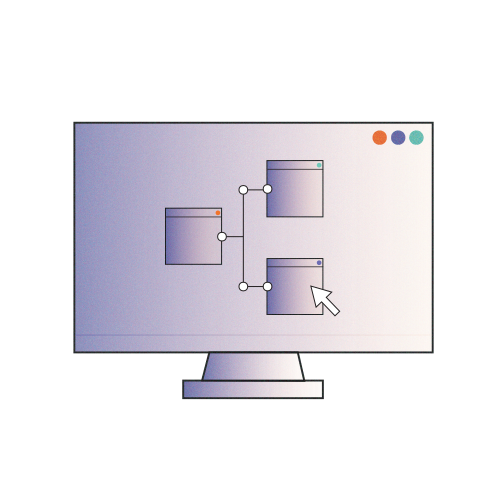
Catalog-of-Catalogs: Alex serves as a unified discovery and governance layer that aggregates and federates metadata from multiple tools. This allows organizations to maintain their existing data dictionaries and glossaries while benefiting from a single pane of glass for lineage and policy enforcement.
-
Modular, API-First Services: Alex delivers every capability (like classification, policy enforcement, and lineage) as a callable, embeddable metadata service. This means you can keep your legacy catalog UI but call upon the superior performance of Alex’s Inference Engine (GenAI Guru) or Automated Lineage engine right where you need it—in a pipeline, a data product, or an external BI tool.
-
Accelerating Time-to-Value: This augmentation approach accelerates adoption because it leverages familiar tools while injecting immediate value. This strategy immediately addresses the common lack of adoption seen in older platforms, which struggle to interface with modern cloud data stacks.
2. The Lineage Accelerator: Unlocking Frozen Assets
Our Lineage Accelerator messaging speaks directly to the core pain point of legacy environments: the time, cost, and complexity of achieving accurate, end-to-end lineage.
-
Automated Lineage Engine: We target the most burdensome manual task—lineage tracing—and automate it with over 95% accuracy. This instantly provides the foundational transparency needed for regulatory compliance (e.g., CCPA or DORA) without touching the core data sources.
-
ERA as the Insight Layer: The Enterprise Reporting & Analytics (ERA) layer acts as a unified observability platform for all your metadata. It monitors signals from both the Alex platform and connected legacy systems, instantly detecting anomalies, policy drift, and data quality gaps, turning static data into actionable governance intelligence.
-
Governed Automation and Playbooks: Through OpenMetaHub and modular Playbooks, Alex can augment legacy governance workflows. For instance, an outdated data classification found in an Informatica metadata store can trigger a real-time, governed Alex Solutions Playbook to correct the classification and notify the relevant data steward—all without requiring a risky platform change.