



Beyond the Firefighting: Automating Platform Monitoring to Lower Data TCO
Audience: Data Engineering Leads, CDOs, IT Operations
Executive Summary
Modern data platforms serve as the foundational engines driving critical executive decisions and customer experiences. Yet, manual troubleshooting and broken pipelines continue to inflate data TCO and erode enterprise trust.
By transitioning to an active metadata fabric driven by Alex Solutions, organizations can automate platform monitoring. This approach protects data quality and secures downstream business reporting proactively.
List of Contents
The Hidden Financial Drain of Reactive Data Operations
How much time does your data engineering team spend diagnosing broken pipelines instead of building strategic value? In the modern enterprise, data organizations continuously struggle with fragmented visibility. Silent data drift and a lack of interoperable execution across their stacks compound this issue.
When a pipeline fails or an upstream schema changes, the immediate response is almost always reactive troubleshooting. Engineers log into disconnected infrastructure components. They pore over raw execution metadata and manually attempt to trace dependencies.
The Cost of Manual Troubleshooting
This manual approach dramatically inflates the Total Cost of Ownership (Data TCO) for enterprise data landscapes. It leaves leadership teams vulnerable to flawed reporting, missed service level agreements (SLAs), and severe data quality issues.
To stay competitive and operationally resilient, organizations must transition from manual operational monitoring to a unified, automated approach. Leveraging an Enterprise Data Operations Platform ensures that technical anomalies are instantly translated into business-level accountability. This drives down engineering overhead and secures continuous enterprise SLA compliance.
Controlling the Blast Radius with Active Metadata
A broken transformation pipeline is rarely just an isolated technical failure. In practice, a data break ripples across the entire corporate ecosystem. It directly impacts revenue-generating reports, customer-facing applications, and executive dashboards.
Without comprehensive operational observability, quantifying the exact blast radius of an incident becomes a time-consuming, highly manual effort.
Mapping the Enterprise Ecosystem
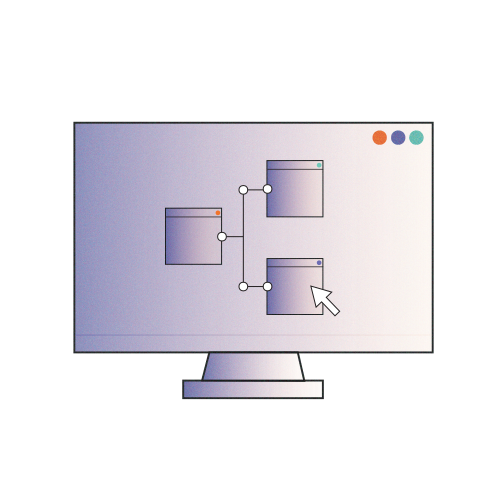
To address this challenge, Alex Solutions introduces an active metadata fabric. This functions as a live operational lens over your entire data landscape.
By leveraging our Open Scanner Ecosystem, Alex Solutions continuously imports operational metadata directly from execution layers like dbt. It brings this information into the same environment where users already explore and govern their data.
Real-Time Continuous Compliance
When a failure occurs, Automated Lineage enables continuous compliance by mapping every transformation in real time. This explicit capability is delivered through Alex Solutions’ API-first architecture.
You can instantly trace the flow of data from source systems through transformation layers to final BI dashboards. By understanding exactly which downstream models depend on the failed process, organizations can isolate the financial and operational blast radius before corrupted data reaches the reporting layer.
Shifting from Technical Alerts to Business Accountability
Identifying a failure is only the first step. Resolving it efficiently while maintaining strict governance is where true cost savings are realized. Passive monitoring tools issue generic alerts that require manual interpretation.
In contrast, Alex Solutions employs an advanced Inference Engine. This sophisticated layer performs an AI-powered impact analysis on every incident automatically.
Automated Issue Contextualization
This engine evaluates the operational issue in the context of its downstream dependencies, data security requirements, and business relationships. The assessment results are written directly back to the impacted assets.
Engineers receive immediate visibility into the issue, contextual explanations, and a clear business impact summary. Furthermore, Alex Solutions automatically initiates a remediation workflow, rapidly routing the issue to the appropriate team.
Enforcing Strict Corporate Regulation
This capability is critical for enforcing strict corporate regulation. Global markets feature frameworks such as GDPR and DORA that mandate rigorous oversight of data lifecycles. Having automated, verifiable proof of operational monitoring is no longer optional in these environments.
Because Alex Solutions seamlessly integrates operational signals with lineage intelligence, impacted reports are automatically flagged. Organizations maintain absolute data security and operational continuity seamlessly.
Active Metadata: The Gartner Perspective on Modern Governance
Leading analyst frameworks, including research from Gartner, frequently emphasize a crucial industry shift. Static data catalogs are no longer sufficient for dynamic, hybrid-cloud environments.
Traditional metadata management cannot scale alongside complex modern data platforms. True infrastructure optimization requires an active metadata fabric that captures the live, operational reality of the enterprise.
Transparency and Execution Visibility
Alex Solutions executes on this industry mandate by providing complete transparency into transformation logic and execution visibility. You can view the last run status, execution messages, and compiled code all within a unified context intelligence layer.
By automating the remediation workflow and providing end-to-end visibility, organizations transition from high-cost firefighting to a streamlined workflow. This approach turns technical failures into immediate, automated resolutions.
Key Takeaways & Next Steps
Automated Impact Analysis
Trace schema changes through continuous, multi-hop data lineage to identify downstream risks to reports and ML models before deployment.
Proactive Incident Remediation
Utilize intelligent agents to automatically trigger impact assessment workflows and coordinate remediation tasks across affected systems.
Cost Control via Observability
Decrease Data TCO by replacing manual investigations with real-time operational telemetry and robust context intelligence.
Join Our Upcoming Webinar
Complex enterprise architectures generate a relentless stream of operational telemetry. The true challenge isn’t a lack of information, but rather the inability to convert that raw metadata into immediate, strategic action. Continuing to operate in a reactive, firefighting mode compromises your data quality, strains engineering resources, and inflates infrastructure run costs.
Ready to bridge the gap between technical operations and business-critical outcomes? Don’t miss our exclusive deep dive into automated platform monitoring.
Frequently Asked Questions
1. What is the primary difference between traditional data monitoring and Alex Solutions’ Enterprise Data Operations Platform (EDOP)?
Traditional data monitoring tools focus on isolated, tool-by-tool infrastructure metrics, requiring manual compilation to trace dependencies. The Alex Platform provides a connected, live operational lens across the entire data ecosystem. It uses active metadata to automatically tie technical pipeline execution to business outcomes.
2. How does Automated Lineage help lower Data TCO?
Automated Lineage eliminates thousands of wasted hours spent by engineering teams on manual root-cause analysis. Organizations can instantly map multi-hop dependencies from source systems to BI dashboards. This allows teams to automate impact analysis and resolve failures much faster, drastically reducing operational overhead.
3. How does Alex Solutions support data quality and regulation compliance simultaneously?
Alex Solutions continuously stitches together business, technical, and operational signals. This protects data quality by stopping silent data drift before it impacts executive decisions. Simultaneously, it provides the continuous, verifiable lineage required to satisfy strict regulatory frameworks like GDPR and DORA.