



A Data Intelligence Framework for AI Readiness
Executive Summary: Despite significant capital expenditure on artificial intelligence, over 90 percent of companies are speeding up AI investments. However, only 21 percent have successfully operationalised the mature governance models needed to scale them. Consequently, the main roadblock is a basic lack of trusted data context, clear history, and automated compliance. Therefore, to cross this gap, organisations need a complete setup for data intelligence, powered by an active Enterprise Data Operations Platform.
Contents
The Daily Reality of Disconnected Data
In today’s economy, data leaders must deliver fast AI results and cut system costs. Yet, the daily reality is that many companies rely on old governance tools that act like static storage. Furthermore, these old setups need manual updates, creating delays that slow down teams and leave AI models without the facts they need to be accurate and clear.
As a result, when data stays hidden in silos, the business impact is harsh: AI projects fail due to bad inputs, risks rise as rules outpace manual checks, and costs swell from extra, unused tools.
Building a Framework for Data Intelligence
To overcome this, bridging the gap between AI goals and daily work requires a shift in design. Specifically, companies must move past static storage and use a unified, automated setup powered by active metadata.
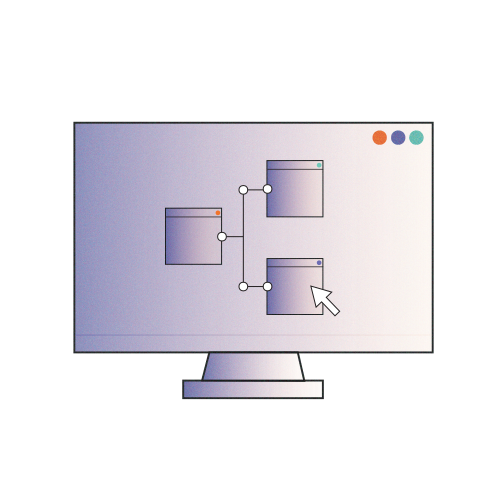
By constantly tracking metadata, data history, and operational signals, this design builds an enterprise knowledge graph. Operational telemetry (or signals) refers to the constant stream of data your systems make as they run. Instead of just writing down what a table is, these signals track how it acts in the real world—capturing details like query run times, data volume shifts, user access habits, and pipeline failure rates.
By feeding this real-time data into the framework, the system shifts from a passive catalog to an active, living network. Ultimately, this creates a smart layer that understands links, finds meaning, and manages actions across the entire data setup—from Snowflake and Databricks to BI tools and AI models—without needing manual work.
Running AI, Cutting Costs, and Staying Safe
Indeed, using this setup for data intelligence shifts data governance from an administrative burden to a powerful business booster. Thus, organisations achieve three specific business wins:
Trusted Data for AI Readiness
Crucially, AI agents and models are only as good as the data they consume. Therefore, by linking technical metadata with business meaning and clear data history, the setup provides the strict proof and clarity needed to launch AI safely into the real world.
Automated Data Compliance
Meanwhile, as legal rules get stricter, manual auditing is no longer enough. To fix this, using smart agents and ready-to-run Playbooks allows you to enforce rules in real time, automatically making audit-ready proof and tagging sensitive data.
Platform and Asset Clean-Up
Finally, to reduce delays and control costs, the setup spots unused datasets, extra pipelines, and overlapping BI reports. In turn, this helps companies clean up their data setups, wipe out tech debt, and lower total system costs.
The Cost Factor: Growing the Framework Efficiently
Moreover, matching daily work with budget limits requires a close look at platform costs. Historically, old vendor models punish growth through unpredictable usage fees, per-user licenses, and exorbitant per-connector costs.
In contrast, the Alex Solutions pricing model is built to deliver cost-effective scale. Thus, by offering a single platform price, unlimited native connectors, and a fixed price ceiling for your contract, companies gain steady system costs without losing features. Ultimately, this clear approach allows businesses to achieve what Gartner analysts describe as getting a “Bentley for the price of a Ford,” routinely cutting total costs by 40 to 60 percent each year compared to older choices.
Frequently Asked Questions (FAQ)
Q: What sets an active metadata framework apart from old data governance?
A: Old governance relies on manual work and acts as a static record. An active metadata design constantly watches signals, data history, and system shifts to build an enterprise knowledge graph. This allows the system to move from passive notes to automated rules and managed actions across the data network.
Q: How does this framework ensure AI models use trusted data?
A: AI models need strict proof to ensure accuracy and clarity. By linking technical metadata with business meaning, the setup maps exactly where data started, how it changed, and who owns it. This smart context stops AI from using unchecked or unsafe inputs.
Q: How is automated compliance enforced across different systems like Snowflake or Databricks?
A: The framework uses smart agents and ready-to-run Playbooks to treat rules as code. Rather than making data engineers manually script access limits, the smart layer reads confirmed tags from the knowledge graph and hands off tasks directly to partner platforms—such as automatically applying data masking rules at the source.
Q: Why is the pricing model important for metadata scale?
A: Because data volume and connection points grow fast, usage-based pricing or per-connector fees quickly become too costly. A cost-effective model—using a single platform price and unlimited native connectors—ensures that companies can scan their entire network and grow their smart layer without unexpected budget spikes.
Ready to Bridge the Execution Gap?
Check your current metadata setup against your AI and compliance goals. Schedule a quick demo to see how the Alex Enterprise Data Operations Platform can improve your specific systems.